AI Workflows — Clinia
Research and design of a visual workflow system that gives Clinia the autonomy to create, connect and customize AI-driven care flows — without relying on single, rigid prompts.
- Company
- Clinia
- Duration
- 6+ months
- Tools
- Figma · Hotjar · Maze · FigJam · HeyMarvin
- Role
- UX Designer responsible for discovery, flows and the design of the AI workflow system
- Skills
- Interviews · User testing · User flow · Wireframing · Prototyping · User research · UX Design · Design System
About the project
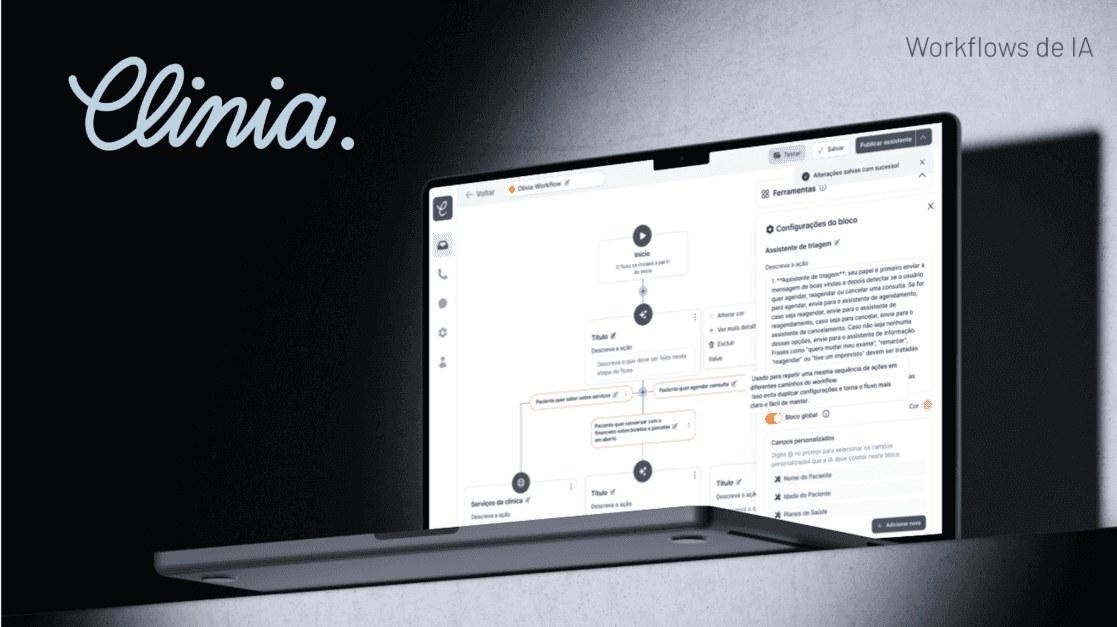
Clinia is an AI platform for clinics and hospitals, used to automate patient care and communication. This project was dedicated to designing AI Workflows: a visual system that lets Clinia's team build, connect and customize AI agents' conversation flows — replacing reliance on a single written prompt with clear, reusable block logic.
The problem
Users struggled a great deal to write a single prompt that covered every point needed for the AI to work well — which also opened the door to errors, since one generic prompt couldn't handle every care scenario. On top of that, relying on written prompts made personalization rigid and made it harder to map out distinct care flows for the AI to follow.
Our goals
Make AI use more flexible. Let agents adapt to the conversation's context instead of depending on one fixed prompt.
Enable visual creation of smart workflows. Give the team autonomy to build and adjust flows without relying on code or rewriting entire prompts.
Connect steps and rules intuitively. Each workflow block connects to clear conditions, making the whole flow easy to understand.
Improve the experience at every level of complexity. From the simplest question to booking an exam, the conversation needed to adapt without losing clarity.
Design process
Discover: understanding users' main pain points through user-driven research. The process included 6 in-depth interviews, session and click analysis in Hotjar to identify friction points, and a detailed benchmark of AI workflow solutions available on the market.
Define: defining the problem as a whole and how it would be solved. Every finding was organized and grouped in FigJam and Notion, centralizing insights and learnings. The main needs identified were autonomy (more freedom to build flows independently), visualization (a more visual interface, less dependent on text), and clarity (in the workflows' activation rules).
Develop: building the solution and usability testing. I moved from low-fidelity wireframes to building the screens in Figma and prototyping: turning ideas into navigable prototypes, usability tests with direct observation to spot confusion points, and fast iteration until a validated version, adjusted from user feedback.
Deliver: handing the developed interfaces off to developers. The handoff was detailed, with interactive final prototypes, documentation of the design system's use — including components, tokens and usage rules — and mapped use cases for quick reference, plus ongoing research to understand how the feature performs in production.
The solution
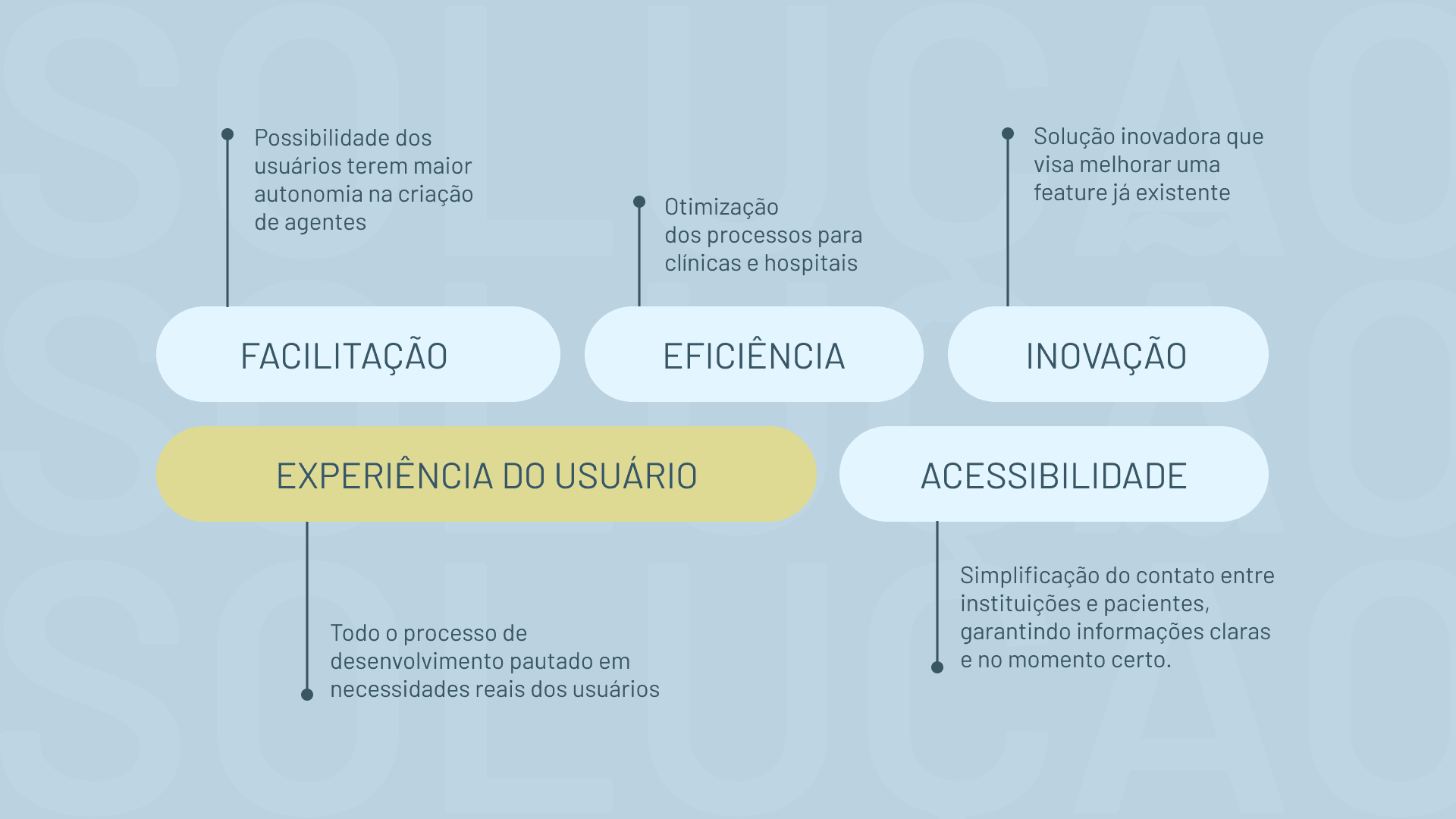
Facilitation. Giving users greater autonomy in creating agents.
Efficiency. Optimizing care processes for clinics and hospitals.
Innovation. An innovative solution aimed at improving an existing platform feature.
User experience. The entire development process was grounded in users' real needs.
Accessibility. Simplifying contact between institutions and patients, ensuring clear information at the right moment.
Solutions built
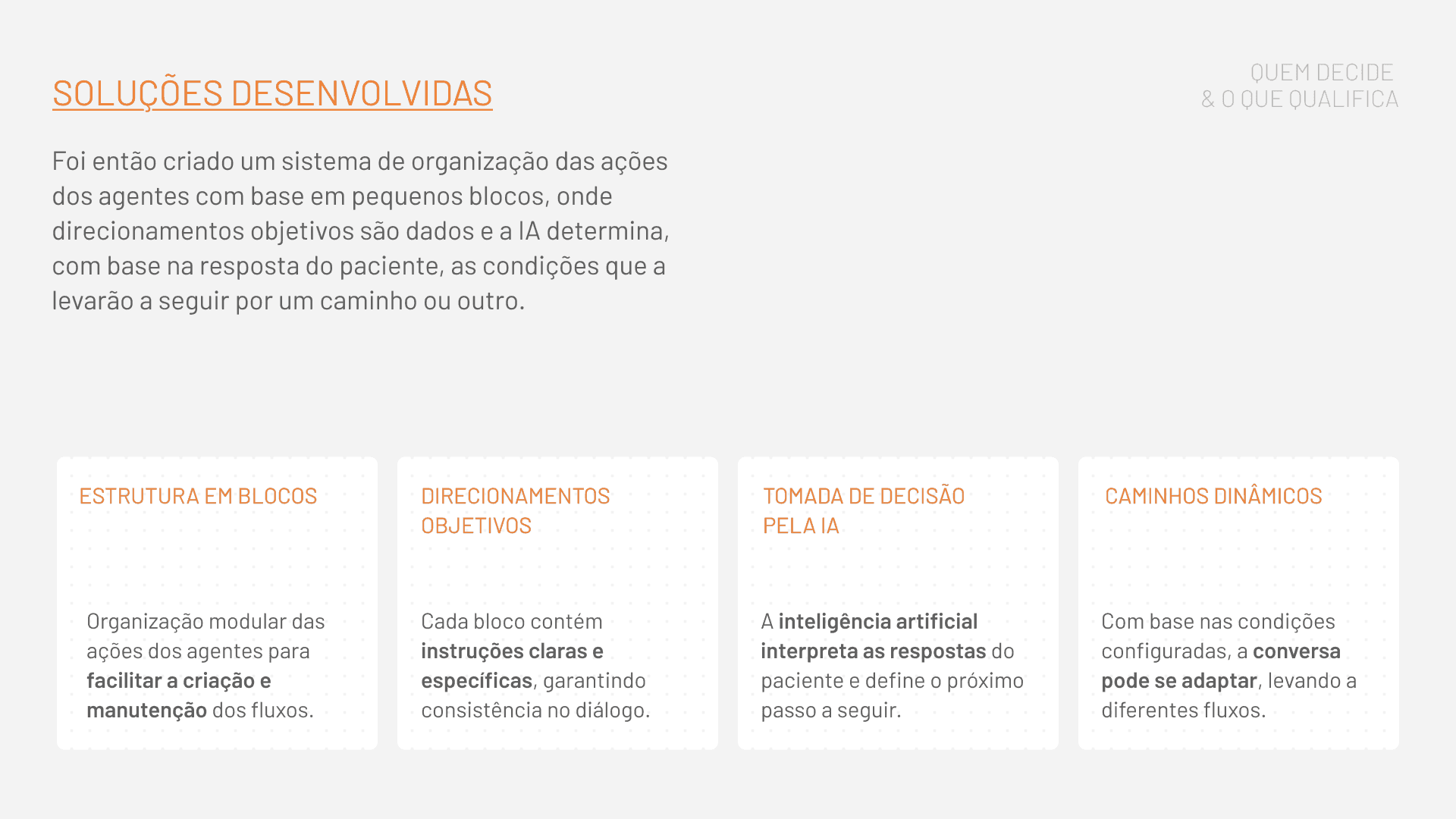
Block structure. A modular system was created to organize agent actions into small blocks, making flows easier to build and maintain.
Objective guidance. Each block carries clear, specific instructions, keeping the dialogue consistent.
AI-driven decisions. The AI interprets the patient's answers and determines the next step.
Dynamic paths. Based on configured conditions, the conversation can adapt and branch into different flows — the AI decides which path to follow based on the patient's answer.
Real results
These numbers show the performance of the AI agent used by Mamorad during March 2025. The data shows a direct impact on operational efficiency, cost savings and higher appointment conversion.
84.9%
of conversations resolved by the AI
74.5%
of new customers booked exams
337
bookings made automatically
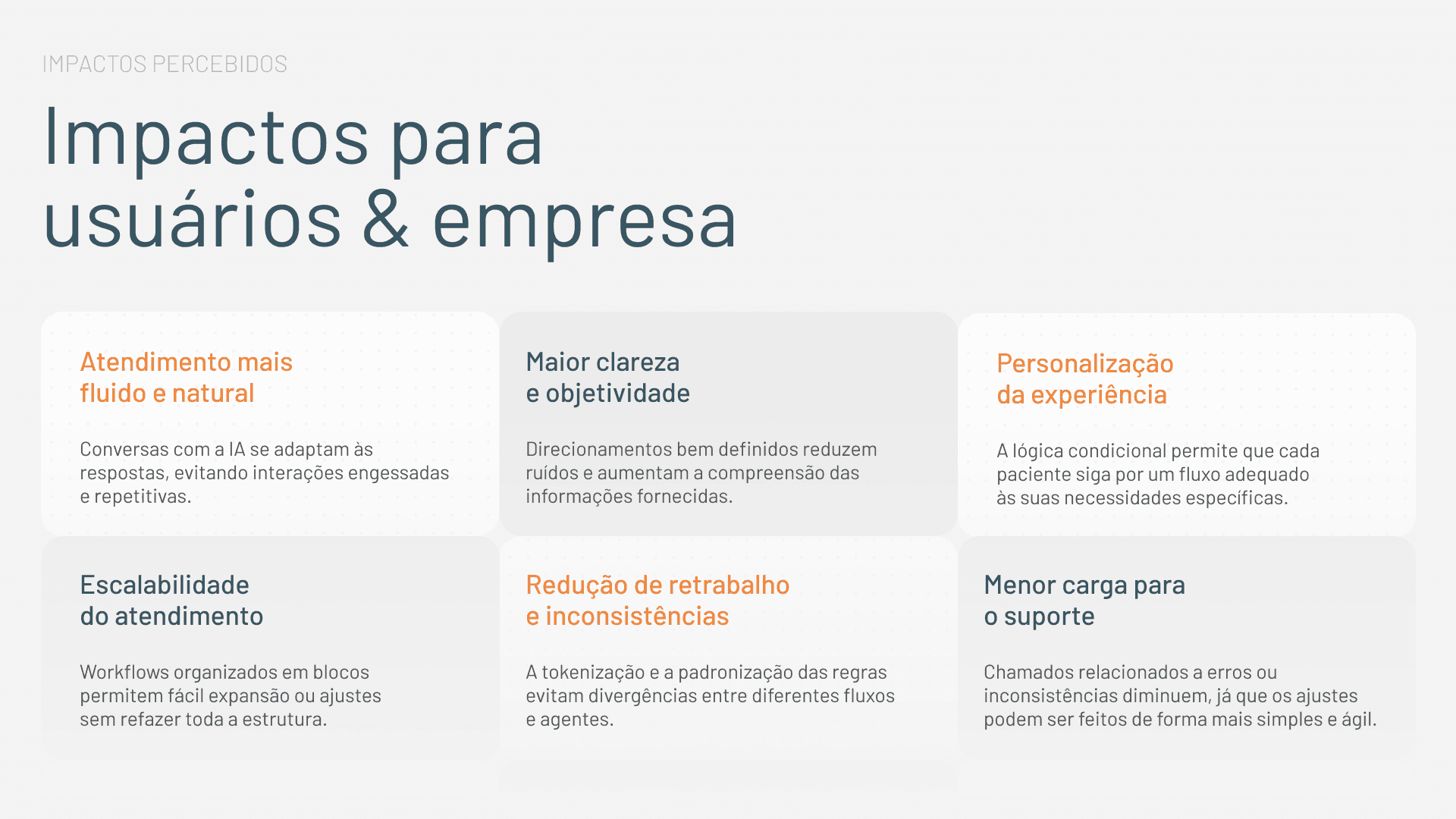
Impact on users
Smoother, more natural conversations. AI conversations adapt to the answers given, avoiding rigid, repetitive interactions.
Greater clarity and focus. Well-defined guidance reduces noise and improves understanding of the information provided.
Personalized experience. Conditional logic lets each patient follow a flow suited to their specific needs.
Impact on Clinia
Scalable care. Workflows organized into blocks make it easy to expand or adjust without rebuilding the whole structure.
Less rework and fewer inconsistencies. Tokenizing and standardizing rules avoids divergence between different flows and agents.
Lighter support load. Tickets related to errors or inconsistencies drop, since adjustments can be made more simply and quickly.
Biggest project learnings
Base decisions on evidence. With AI, there's still a lot of uncertainty — user research helped validate hypotheses and steer development toward real needs, not just "technically possible" solutions.
Trust has limits. Users have different levels of trust in AI interactions; the research surfaced friction points and expectations around clarity, transparency and information security.
Iterate with constant feedback. Frequent research and testing showed that the design system and workflows need to evolve alongside what users — and the AI itself — learn.
Guide innovation responsibly. The research ensured decisions about AI weren't driven only by technical possibility, but by real impact on users' lives, balancing innovation, ethics and usability.
“UX Research isn't just support: it's the compass that keeps innovation moving alongside people's real needs. Only research that puts the user at the center of decisions can lead to the best possible solutions.”
Conclusion
The AI Workflows project gave Clinia a visual, modular system for building, connecting and customizing AI agents' care flows — replacing the rigidity of a single prompt with clear, reusable, easy-to-maintain blocks. The real results confirm the impact: 84.9% of conversations resolved by AI, 74.5% of new customers booking exams, and 337 automatic bookings in a single month. Beyond the numbers, the project reinforced that research and constant iteration are what keep AI innovation aligned with users' real needs.