March 10, 2023
Basic guide: Design Thinking in the UX process
A complex task
First of all, let's be clear: this isn't a 5-step tutorial. But if you're looking for direction, here's a starting point. We want to show you the tools you can use as a UX Designer and help you think critically about when and how to use them.
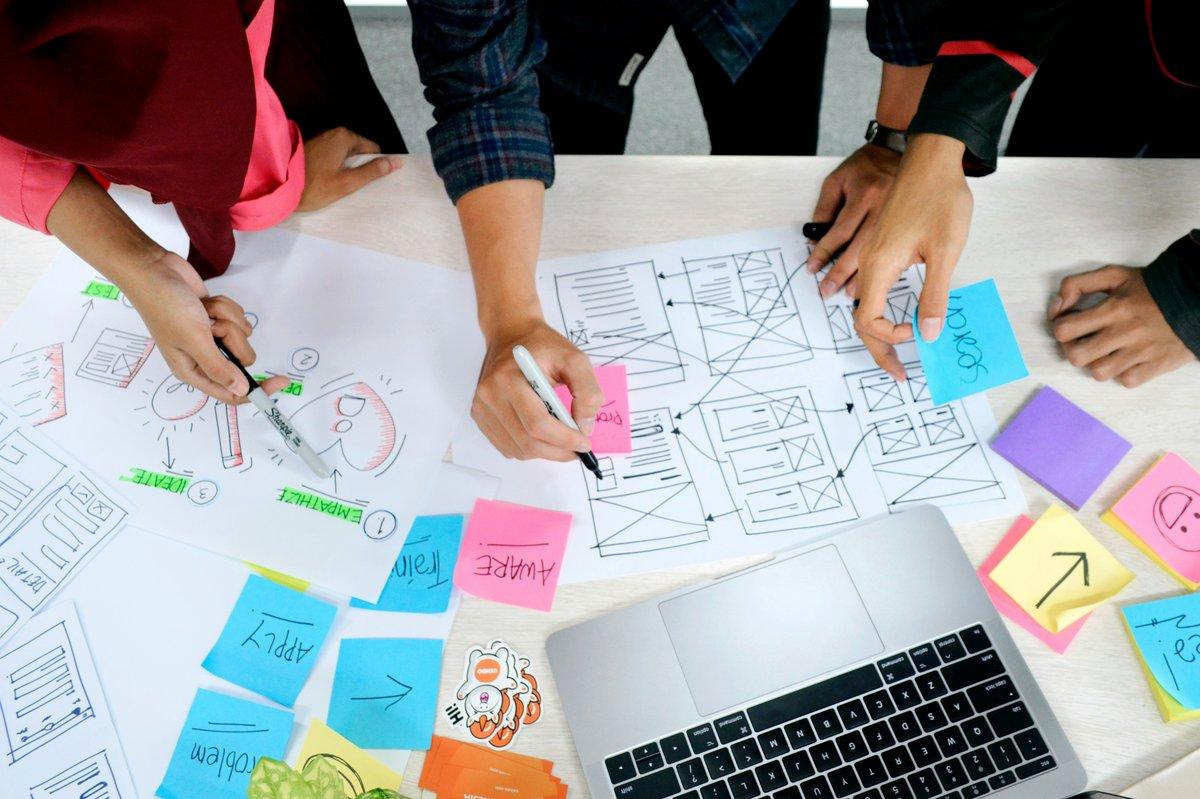
Building a UX case study can be a fairly complex task, and it acts as a turning point in shaping a good user experience. In this article, we map out the stages of the Design Thinking (DT) approach and list some of the most commonly used supporting tools to get through all of them — so that you can build scalable projects that generate real value. And if you're learning this on your own, don't give up: practice is how you learn.
To help you navigate → this text is split into three main fronts: a brief clarification of the field, and the stages of the process.
A brief clarification
User Experience
The term was coined by Don Norman — co-founder of the Nielsen Norman Group, university professor and author of the classic “The Design of Everyday Things” — back in 1990, while he was still VP at Apple. The core concept behind UX is User-Centered Design (UCD): you need to understand who the user is and how to offer them the best possible experience, since every user will have a unique experience shaped by their own history and mental models. UX Design is a broad, constantly evolving field that spans competencies such as research, interaction design, information architecture, visual design, psychology, and more.
“User experience encompasses all aspects of the end user's interaction with the company, its services, and its products.”
Design Thinking
Design Thinking is a human-centered approach used to solve complex problems in search of innovative solutions — one that also relies on other tools to achieve the expected results. Also described as a mindset, it has been discussed for decades by scientists and researchers. One of the first to write about it — in “Wicked Problems in Design Thinking” — was Richard Buchanan, who framed DT as a field that reaches beyond academia, to anyone who needs to solve complex problems in their day-to-day work. Other well-known names include Nobel Economics laureate Herbert Simon and Robert H. McKim.
However, the people who actually brought DT into the spotlight were David Kelley, a Stanford University professor, and Tim Brown, author of “Change by Design.” Together they founded IDEO, the innovation consultancy and the main force spreading Design Thinking around the world. Brown introduced Design Thinking in the Harvard Business Review in 2008, and the approach has resonated worldwide ever since, especially across the tech industry.
“The process is not only human-centered, it's deeply human in and of itself. Design thinking relies on our ability to be intuitive, to recognize patterns, to construct ideas that have emotional as well as functional meaning, to express ourselves in media other than words or symbols.”
A creative and flexible process
Because it's a creative, flexible process, several DT models have emerged over the years. The core pillars of DT, in any framework, are empathy, collaboration and experimentation. There's no single consensus on the ideal DT model — its structure varies depending on the company, the product, the people involved, and the number of phases or tools applied. This is what allows people who weren't trained as designers to think like designers and use creative tools to tackle a wide range of challenges. And despite these adaptations, it's the design process that puts Design Thinking into action, and its core structure remains:
- Research
- Generate ideas
- Prototype and test
- Focus on user needs
“Design thinking is a human-centered approach to innovation that draws from the designer's toolkit to integrate the needs of people, the possibilities of technology, and the requirements for business success.”
Main Design Thinking models
Below are the main models used today.
- IDEO
- d.school (Stanford University)
- IBM Enterprise Design Thinking
- Design Council (UK)
Tools are a means to an end. It's important to treat any tool as a compass for solving problems — sometimes you can follow every instruction to the letter, and when needed, adapt it to the problem at hand.
From here on, we'll continue our journey by exploring the Design Council's (UK) Double Diamond model, and we'll also show some supporting tools to use along the way — starting with how to run broad research to raise hypotheses, moving into moments of choice, and finally arriving at a proposed solution.
Double Diamond Design
The methodology was created by the Design Council in 2004 to clearly convey design processes and methods to everyone. The Double Diamond (DD) is a methodology that, through design principles and methods, helps guide the solution-development process. The first diamond is about exploring deeply and generating ideas around the problem. The second diamond takes focused action to narrow down the number of ideas, generates operational possibilities for those solutions, and then focuses on just one of them.
“Every designer has a different approach and way of working, but there are some commonalities in the creative process.”
The main goals of using the Double Diamond:
- Assess a problem and understand the best approach, strategy and time management for tackling a specific challenge
- Help align and focus teams at the start of a project
- Track a project in terms of 'where we are in the process' and 'what the next steps are'
Stages of the process
It's not a linear process. The tools can vary depending on the problem and your team's needs. You might discover unmapped adjacent problems in the first or second diamond, or findings that need to be explored further — you may even need to redo part of the process, and that's fine. It's completely normal!
Before we start, it's important to keep in mind: UX Designers understand how the people using a given service or product interpret and interact with the world, and design emotion-focused solutions to deliver pleasant experiences.
Discover
In the first phase of the diamond, you need to diverge in order to discover. The main goal here is to understand (to empathize) rather than simply assuming and jumping straight to tackling the problem. What matters is staying open to everything you observe about the problem, instead of just trying to come up with different solutions for it.
💡 At this stage, the essential thing is to understand the problem, not to solve it.
To complete this stage, you'll need to:
- Understand the business
- Get to know the users, their pains, needs and motivations
- Understand the context of use
- Research the current conditions that attempt to solve this problem
Tools that can help you complete this phase:
- Kick-offs
- Start With Why?
- CSD Matrix
- Desk Research
- Benchmarking
- Proto-persona
- Empathy map
- In-depth interview
- Personas
💡 Benchmarking is the analysis of competitors, and a benchmark is the company used as a reference for something. Example: Apple is a benchmark for simplicity and sophistication in device design.
💡 A proto-persona is built from the team's own ideas and perceptions about the product or service — it's a hypothesis of the persona. Once a proto-persona is defined, it can be used as a basis for user interviews to design the actual persona, turning those hypotheses into questions to be validated with real people. A persona, on the other hand, is built on prior research and data collected from real users.
With the findings from the discovery stage around the problem at hand, we move on to the Define stage, to structure and understand what the real problem to be solved actually is.
Define
Based on that earlier understanding, in this stage we define the real problem to solve. This brings together perceptions and general insights from the process, which will help guide the project through the current stage. This is the moment when all the users' real needs are surfaced, and solutions to the problems found are decided on.
There's one key question to ask, which will be used as the basis for everything that follows: what problem do we want to solve?
Through a few important points within this stage, we can understand how to surface the needs and ideas that will actually impact the usability of a given product or service.
Tools that can help you complete this phase:
- Focus group definition
- Evaluation criteria
- Annotation analysis
- Drivers and hurdles
- Emotional journey
Once the problem to be solved is clear and every step within the Define stage is complete, it's time to move on to the Develop stage.
Develop
We've reached the second diamond, and it's time to diverge again. After mapping the problem and the possibilities uncovered, we move into a deeper search through other existing solutions.
The goal is to see what's already being done to solve this problem, whether it serves as inspiration or not. It's important not to be limited by boundaries or judgment — exchanging knowledge between team members is also essential. This is a great moment to bring in people from other areas so they feel like co-authors of the final solution and help spread design thinking to the rest of the team, in case their UX maturity isn't very developed yet. After all, two heads think better than one. Challenge assumptions and generate ideas.
Tools that can help you complete this phase:
- How might we
- Job stories
After immersing yourself in existing solutions and comparing them with the problem you want to solve, it's time to analyze and compile the insights, inspirations, gaps or opportunities for building the prototype — or, in some cases (and believe it, this is normal), the problem you identified might already have a solution, and you'll need to go back to the first diamond to see whether there's another problem that, based on your findings, offers more room for opportunity, before finally moving on to prototyping and delivery.
Deliver (prototype)
It's during the prototyping stage that ideas become a tangible product. Prototypes are built in all sorts of ways, presenting solutions to the problem and allowing users to have a more realistic contact with the service concept — while also surfacing small, previously unnoticed problems that can then be fixed and improved.
Tools that can help you complete this phase:
- User scenarios
- Prototype
- Crazy 8s
- Navigation flowchart
- Blueprint
- A/B testing
- Usability testing
Validation
Now is the time to bring the team together, share what was learned, and analyze the results of the solution's performance along with any necessary adjustments, aiming for continuity and constant improvement — because the problem-solving process is iterative and never really ends. Believe it: more problems are still on the way.
Tools that can help you complete this phase:
- Information architecture
- Opportunity Solution Tree
- Business model
- Metrics
- Roadmap
- How-Now-Wow Prioritization
An endless cycle of continuous improvement
The most important thing to remember is that design is about solving problems. We need to deeply understand the problem (and bring others along on that journey). Once these new paths are identified, a new challenge appears: how do you get to an MVP (Minimum Viable Product) and bring the solution to market? Combining both diamonds keeps the MVP constantly evolving, always running discovery and research in parallel with development.
The implementation process involves turning innovative ideas into new business. To measure the evolution of the product or service, it helps to pair everything you've discovered with other practices such as Design Sprint, Agile methodologies, Lean Inception, and OKRs (Objectives and Key Results), getting the most accurate solutions to market faster.
There's no fixed definition of how long this should take or how it should be applied. This process can take 3 months and produce an MVP ready to go, or it can all happen in a single week during a Design Sprint and still come out with a ready MVP. It all depends on the problem being solved and the resources available. From here on, you've got a solid toolkit to apply — and it's by practicing that you learn.
“There is no area of contemporary life where design — the plan, the project, or the working hypothesis that constitutes intent in the operations carried out — is not a significant factor in shaping the human experience.”
We know there are many methods, tools and ways to solve problems. But this short journey we've just walked through helped us a lot when we were starting out, and it still helps today. Over time, you'll discover your own way of doing things, flipping the process, adapting it. And when you do, share it with the community — openly sharing knowledge can help democratize UX Design, making our field more inclusive and culturally rich.
So, in your day-to-day work, how do you apply these processes? Had you already used the Double Diamond before? Wishing you success on your journey!
Courses we recommend
- Design Thinking, MOOC Instituto Paula Souza SP
- UX & Design Thinking: Experiência do Usuário nos negócios, Udemy
- Fundação Instituto de Administração (FIA Business School)
- Design Thinking: melhore seus resultados nas mídias sociais, SEBRAE
- Design Thinking, IBMEC
Books we recommend
- Design Thinking: Uma Metodologia Poderosa para Decretar o Fim das Velhas Ideias
- Isto é Design Thinking de Serviços: Fundamentos, Ferramentas, Casos
- Do design thinking ao design doing
- A jornada do design thinking
- Design Thinking Brasil
- Design Thinking e Thinking Design: Metodologia, Ferramentas e uma Reflexão Sobre o Tema
Originally published on Medium: medium.com/@vitoriaasimon